
As a guest
Qwen3.5-9B · MTP · NVFP4
32 GB RAM laptop: Cosmos as a guest of Ubuntu, on one virtual function of the GPU
MSI Prestige 16 AI+ C3MTG · Core Ultra X7 358H · 32 GB
Captured November 8 – 9, 2026 · One captured run per system
Cosmos ran as a QEMU/KVM guest on the laptop's Ubuntu, driving one SR-IOV virtual function of its Arc B390 GPU. Ubuntu stayed in charge of the hardware: its driver set the GPU's clocks and power, and its scheduler ran the guest's CPUs. Against llama.cpp running natively on the same host, with the same weights and the same request, Cosmos still decoded several times as fast, and about as fast as Cosmos booted on the laptop itself.
- Laptop
- MSI Prestige 16 AI+ C3MTG
- CPU
- Intel Core Ultra X7 358H
- GPU
- Intel Arc B390 · Xe3 (integrated)
- Memory
- 32 GB, shared by CPU, GPU and NPU
 (open full size)
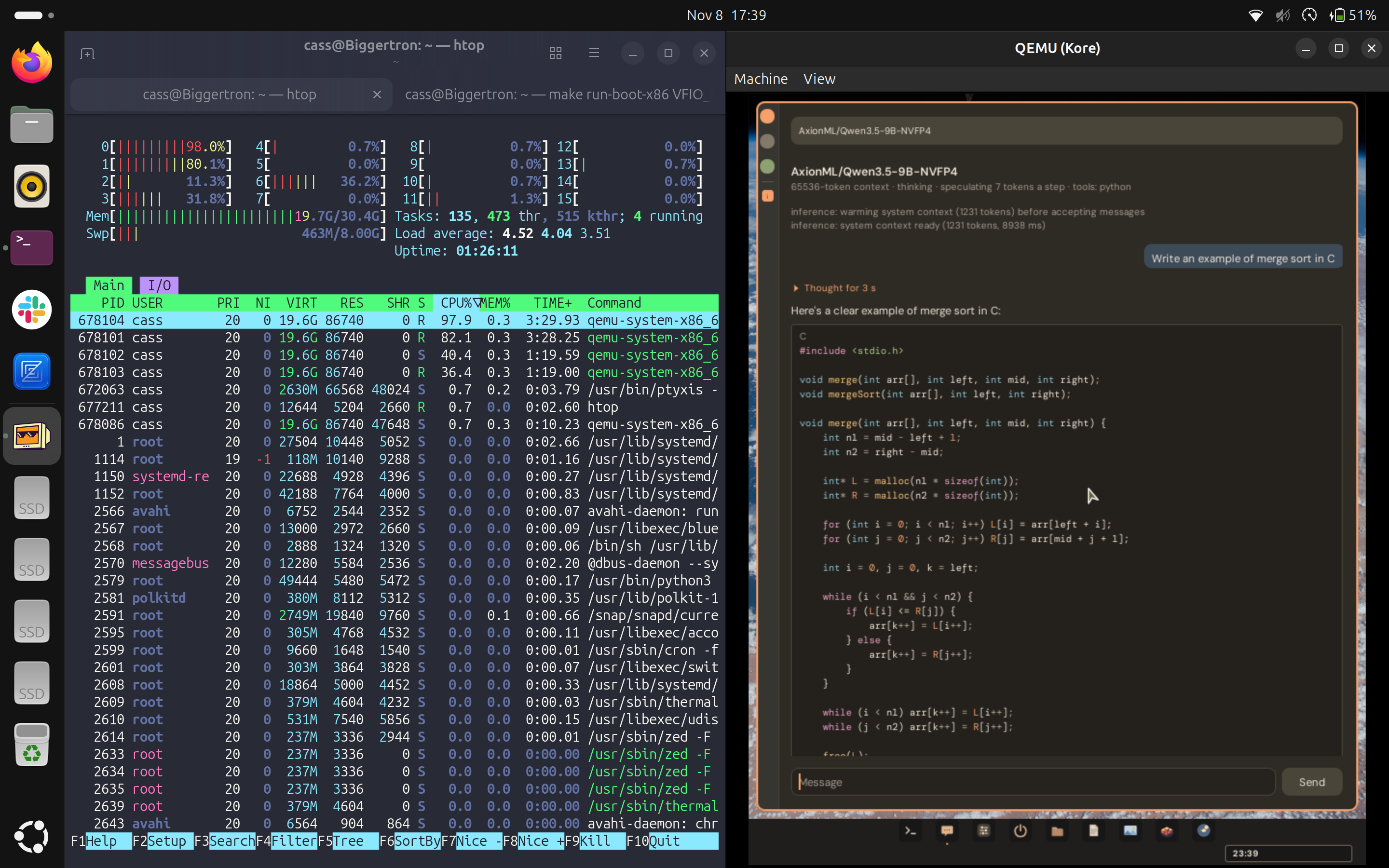
Cosmos in a QEMU window on the Ubuntu host's desktop, the request its first message. Beside it, htop on the host shows QEMU's threads carrying the load.
Decode speed as a guest · 3.4× the speed of Ubuntu + llama.cpp on the same machine · 97% of Cosmos on metal
- Cosmos, as a guest
- 37.9tok/s
- Cosmos on metal
- 38.9tok/s
- Ubuntu + llama.cpp
- 11.11tok/s
Readouts, as shown on screen
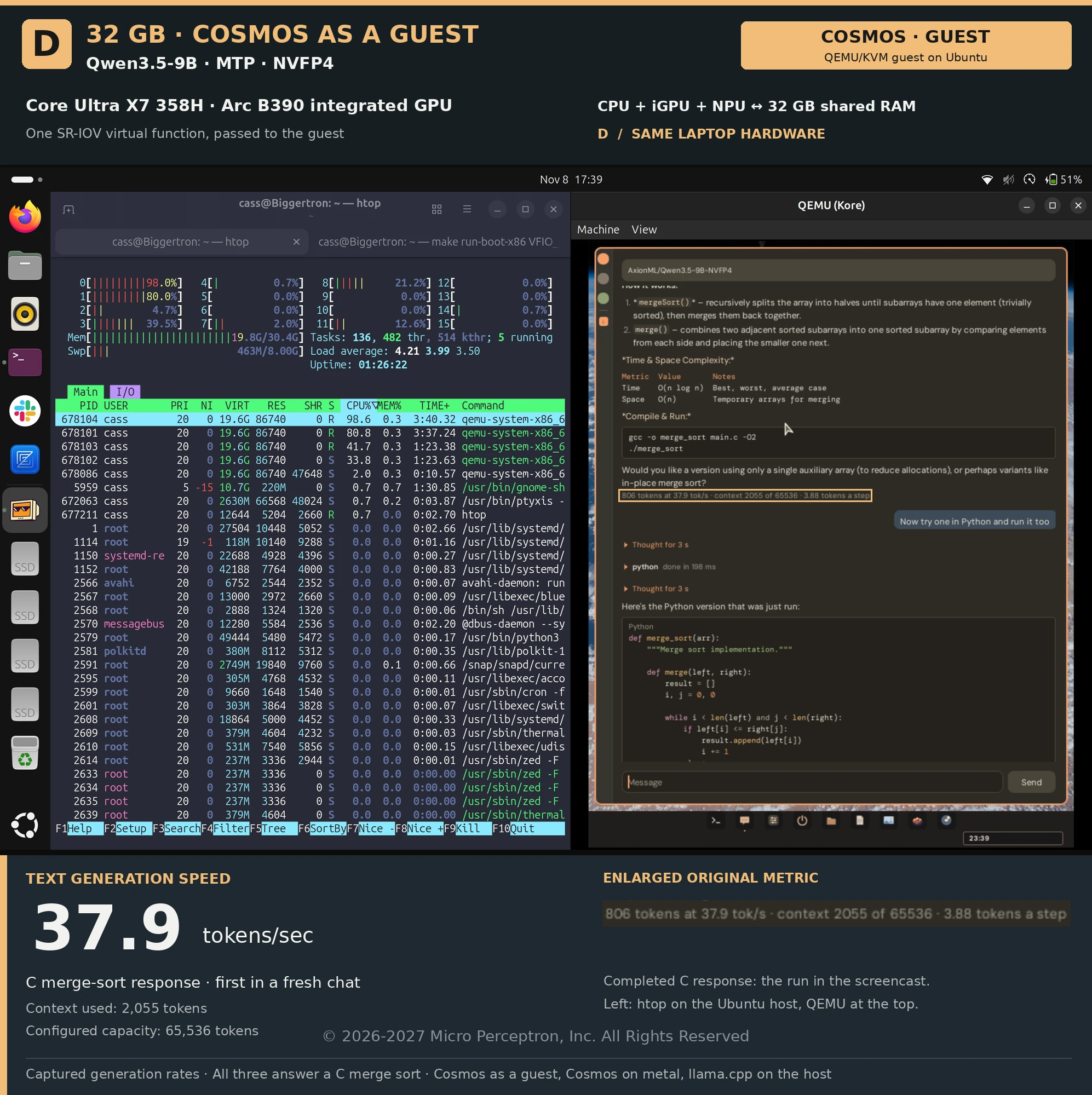
806 tokens at 37.9 tok/s · context 2055 of 65536 · 3.88 tokens a step
Context 2,055 / 65,536 · 3.88 tokens per decode step · The run in the screencast
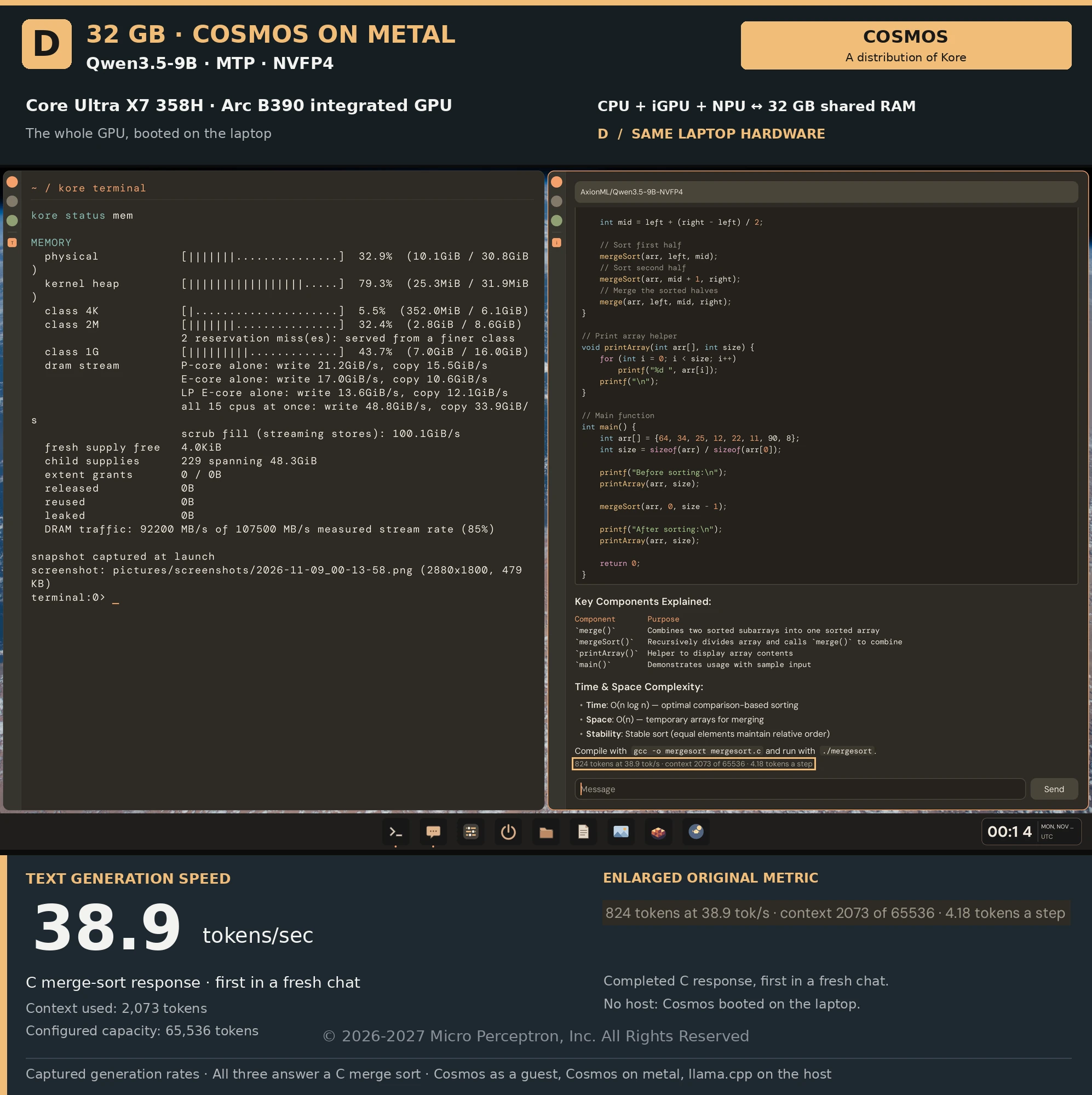
824 tokens at 38.9 tok/s · context 2073 of 65536 · 4.18 tokens a step
Context 2,073 / 65,536 · 4.18 tokens per decode step
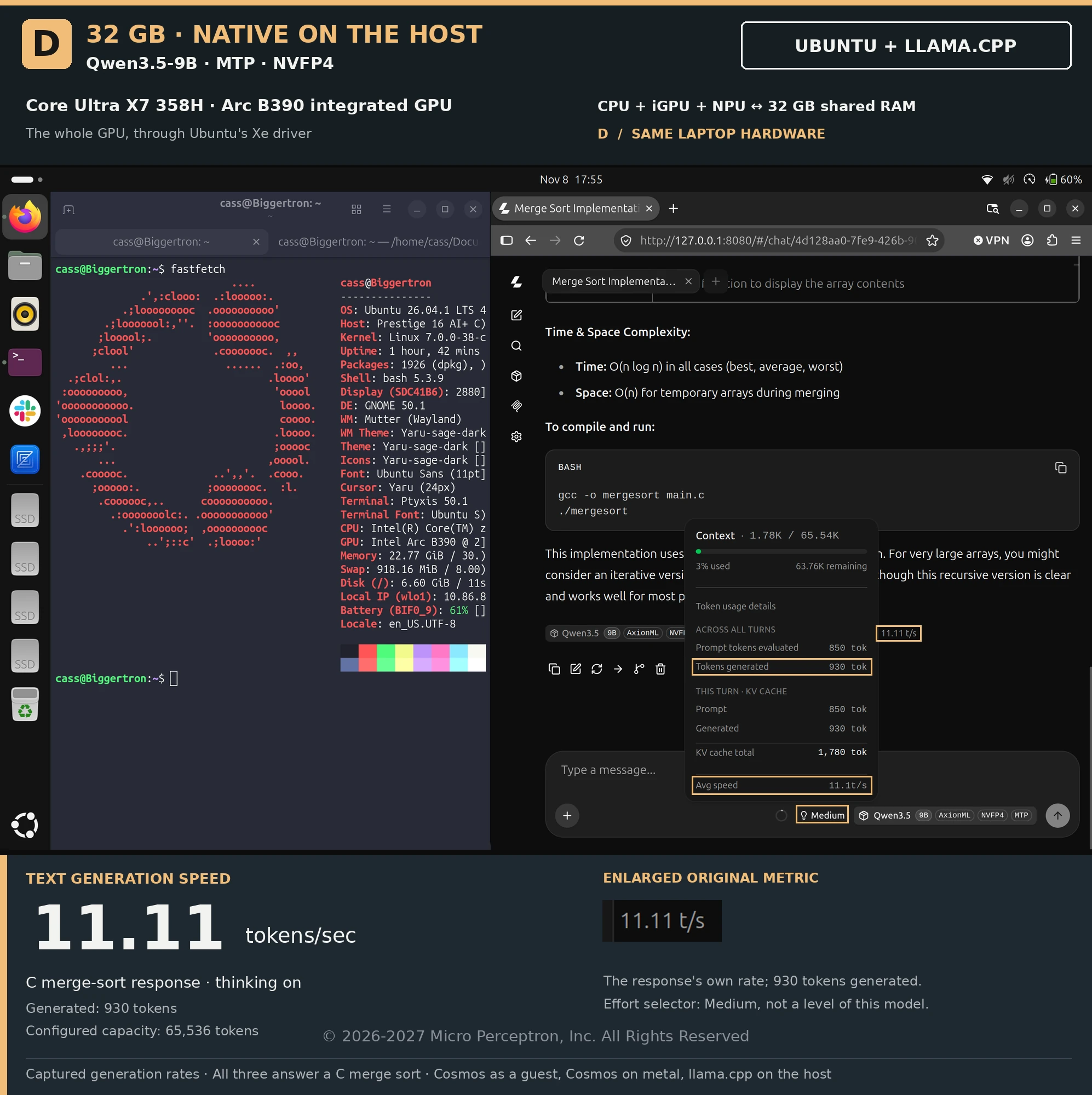
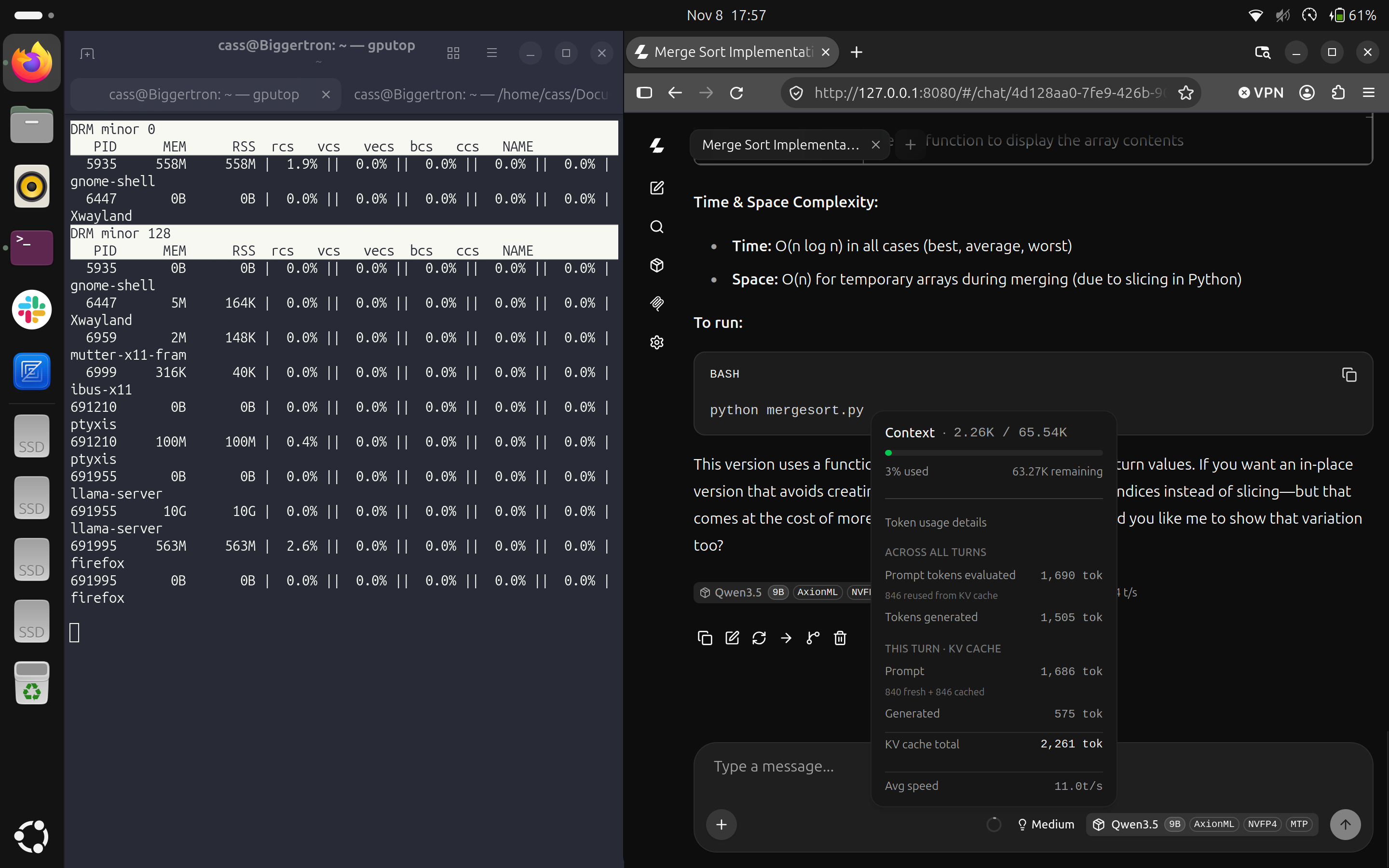
11.11 t/s · Tokens generated 930 tok · Avg speed 11.1t/s
930 tokens generated · Thinking on
Single runs. With MTP, decode speed depends on how many drafted tokens each step keeps, which varies with the text generated: the guest run kept 3.88 tokens a step, the metal run 4.18. A second guest run, three minutes later, read 39.0 tok/s at 3.97; it's with the evidence.
llama.cpp's figure is the response's own rate; its token panel averages 11.1 t/s over the same turn.
What each system ran
- Weights
- AllAxionML/Qwen3.5-9B-NVFP4, with its MTP head
- System
- Cosmos, as a guestCosmos on Kore, as a QEMU/KVM guest
- Cosmos on metalCosmos on Kore
- Ubuntu + llama.cppUbuntu 26.04.1 LTS · Linux 7.0.0-38
- Host
- Cosmos, as a guestUbuntu 26.04.1 LTS · Linux 7.0.0-38 · GNOME 50.1 running
- Cosmos on metalNone: booted on the laptop
- Ubuntu + llama.cppItself · GNOME 50.1 running
- GPU
- Cosmos, as a guestOne SR-IOV virtual function of the Arc B390, through VFIO
- Cosmos on metalThe whole Arc B390
- Ubuntu + llama.cppThe whole Arc B390 · Intel Xe driver
- Clocks, power
- Cosmos, as a guestSet by the host's Xe driver
- Cosmos on metalSet by Kore
- Ubuntu + llama.cppSet by Ubuntu's Xe driver
- CPU, memory
- Cosmos, as a guest4 vCPUs, not pinned: left to the host's scheduler across all 16 cores · all guest memory in preallocated 2 MiB hugepages
- Cosmos on metalThe whole machine
- Ubuntu + llama.cppThe whole machine, under Ubuntu's scheduler
- IOMMU
- Cosmos, as a guestMandatory: the guest's virtual IOMMU, over the host's VT-d
- Cosmos on metalMandatory: VT-d
- Ubuntu + llama.cppOn: VT-d in Linux's default DMA-FQ mode
- Context
- All65,536 tokens
- Runtime
- Cosmos, as a guestKore's inference engine · built-in chat
- Cosmos on metalKore's inference engine · built-in chat
- Ubuntu + llama.cppllama.cpp 0.8.0-dev (build 1, 418f905) · Vulkan, Mesa 26.0.8 · llama-server web UI
- Thinking
- Cosmos, as a guestOn; this model has no effort levels
- Cosmos on metalOn; this model has no effort levels
- Ubuntu + llama.cppOn; the web UI's effort selector read Medium, a level this model doesn't have
Evidence
 (open full size)
 (open full size)
 (open full size)
The guest run from request to readout, in real time, recorded on the Ubuntu host: Cosmos in its QEMU window, htop beside it. It ends on the readout the guest's capture card shows.
Edited for disclosure: one line of the guest's startup log, describing how its speculative decoding is structured, is covered where it appears, for the first 11 seconds, and the cover says so. Nothing else is changed: no cuts, no speed-up.
A 26-second recording of the Ubuntu host's desktop. Left, htop shows CPUs 0 and 1 busy and qemu-system-x86_64 threads at the top of the process list. Right, a window titled QEMU (Kore) shows the Cosmos chat running AxionML/Qwen3.5-9B-NVFP4, its startup log at the top. The request, Write an example of merge sort in C, is sent; the model thinks for 3 seconds, then a C merge sort streams in and the chat scrolls with it: the listing, how it works, its time and space complexity and how to compile it. It ends on the status line 806 tokens at 37.9 tok/s, context 2055 of 65536, 3.88 tokens a step.
 (open full size)
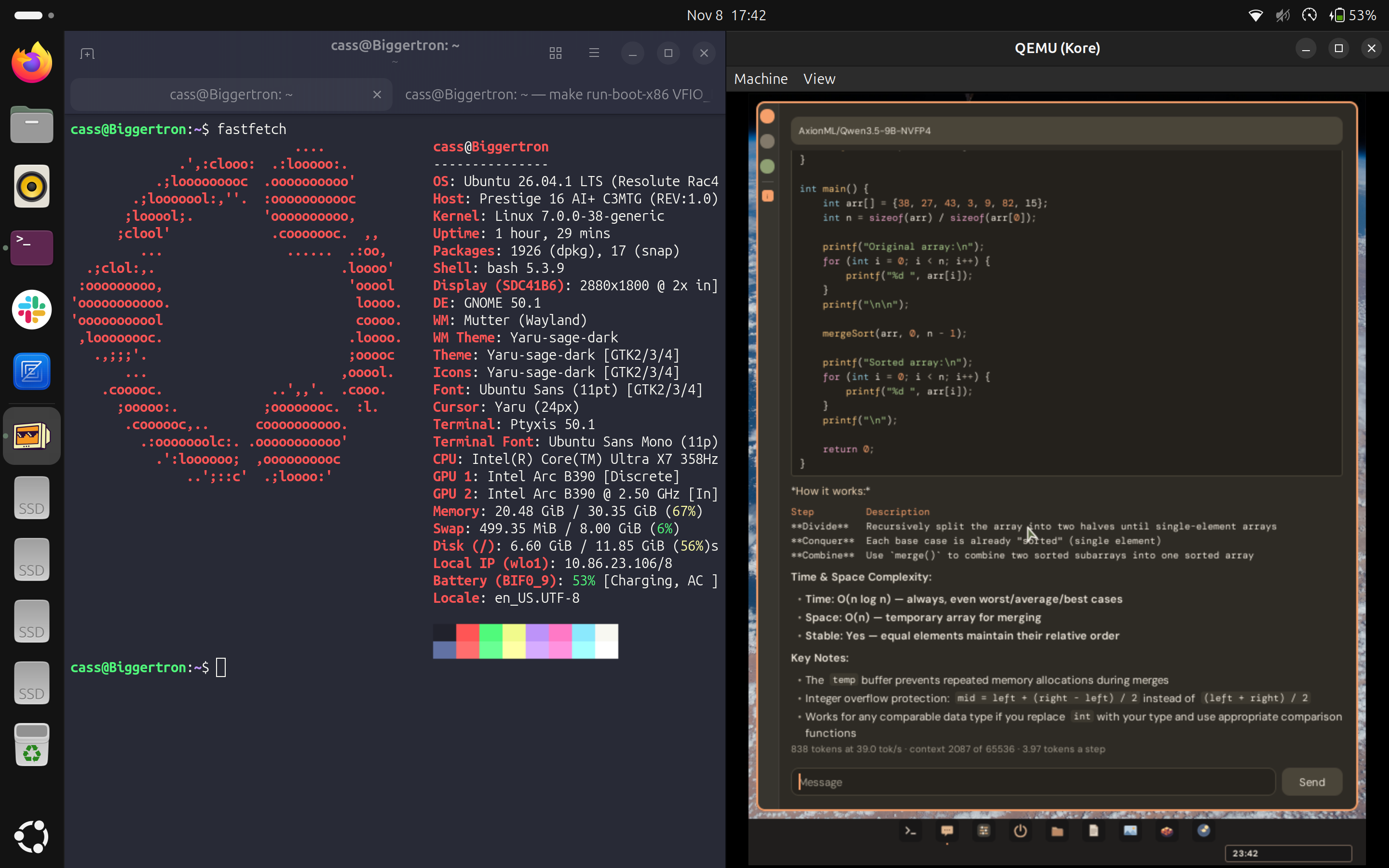
Three minutes later, a fresh chat in the same guest: 838 tokens at 39.0 tok/s, 3.97 tokens a step. Beside it, fastfetch on the host.
 (open full size)
After llama.cpp's turns on the host, gputop lists llama-server holding 10 GB on the GPU.
How it was measured
- Who runs the hardware
- For the guest run, Ubuntu stays in charge. Its Xe driver owns the GPU's physical function and sets its clocks and power; Kore's driver makes no clock or power request from a virtual function, and only reads the clock configuration the host reports. Ubuntu's scheduler runs the guest's four vCPUs as ordinary host threads, unpinned, on whichever of the 16 cores it picks, performance, efficient or low-power. What differs from the llama.cpp run is the software that runs the model.
- Guest setup
- QEMU with KVM on the Ubuntu host: a q35 machine with 4 vCPUs (-cpu host), not pinned to any core; all guest memory backed by 2 MiB hugetlb pages, preallocated at launch; one SR-IOV virtual function of the Arc B390 passed to the guest through VFIO. The host's GNOME desktop kept running throughout.
- IOMMU
- Neither run turned the IOMMU off. Kore keeps its IOMMU mandatory as a guest: the GPU reaches only the memory Kore mapped, through the guest's virtual IOMMU, and the host's VT-d confines the guest on top. On the host, Linux translated the GPU's memory access too, in its default DMA-FQ mode, which batches invalidations rather than issuing each one as it happens.
- Same request
- All three runs answer a request for merge sort in C as the first message of a fresh chat, with the same weights and a 65,536-token context.
- Same machine
- Every comparison ran on one laptop, with the same silicon, drive and model weights on each side. On metal, Cosmos and Ubuntu were booted in turn; a result that ran Cosmos as a guest says how the guest was set up.
- Current baseline
- Ubuntu 26.04.1 LTS on Linux 7.0.0-38 with the latest Intel Xe drivers, on both machines; llama.cpp 0.8, with native NVFP4 and expert-cache support; fio 3.41 with io_uring, direct I/O and registered buffers, as the storage result's commands show. Current releases, not old builds, with one exception: the 27B result's llama.cpp run used an earlier build whose version wasn't recorded, and its settings say so.
- Captured runs
- Each figure is one captured run, read off its screenshot — not an average of repeated runs.
- Native harnesses
- Each system is measured with its own tools: Cosmos's chat and pack bench; llama.cpp's web UI and fio on Ubuntu. Transfer sizes and scheduling are reported, not equalized.
- Units
- Storage in decimal GB/s (10⁹ bytes per second). Tokens per second as each runtime reports its own generation speed.
- Setup excluded
- Buffer allocation and registration happen before timing on both systems; Cosmos prints its setup time on a separate line.
More results
- Local inference32 GB RAM laptop: every weight resident in memory42.5 tok/s · 32 GB
- Local inference32 GB RAM laptop: Qwen3.8-27B, every weight resident24.0 tok/s · 32 GB
- Local inference16 GB RAM laptop: a model larger than its memory, streamed from SSD13.2 tok/s · 16 GB
- StorageNVMe raw read6.02 GB/s · 16 GB