
The gold standard operating system for local AI.

Your models, on your hardware. Built from the kernel up.

Get early access
01 · localYour AI runs here, not in a data center.

On-device AI: models run on the machine in front of you — encrypted at rest, working with no connection at all. Your prompts, your files, and everything the system learns about how you work never need to leave it. Cloud models are a choice you make, never a dependency you inherit.

02 · privatePrivate by construction, not by policy.

Nothing in Cosmos holds standing permission to send your data anywhere. Every access is a capability — an unforgeable token derived from something you granted on purpose — so there's no ambient authority for a model, a tool, or an app to escalate into.

03 · fastEvery chip you own, working at once.

A heterogeneous scheduler places work across CPU, GPU, and NPU the way a kernel schedules threads, so local models get the whole machine. On a 16 GB Lenovo Yoga 7 2-in-1, Qwen3.6-35B-A3B — a 35-billion-parameter model larger than the laptop's memory — decodes at 13.2 tokens a second.

On metal

Local AI, running today at state-of-the-art speed.

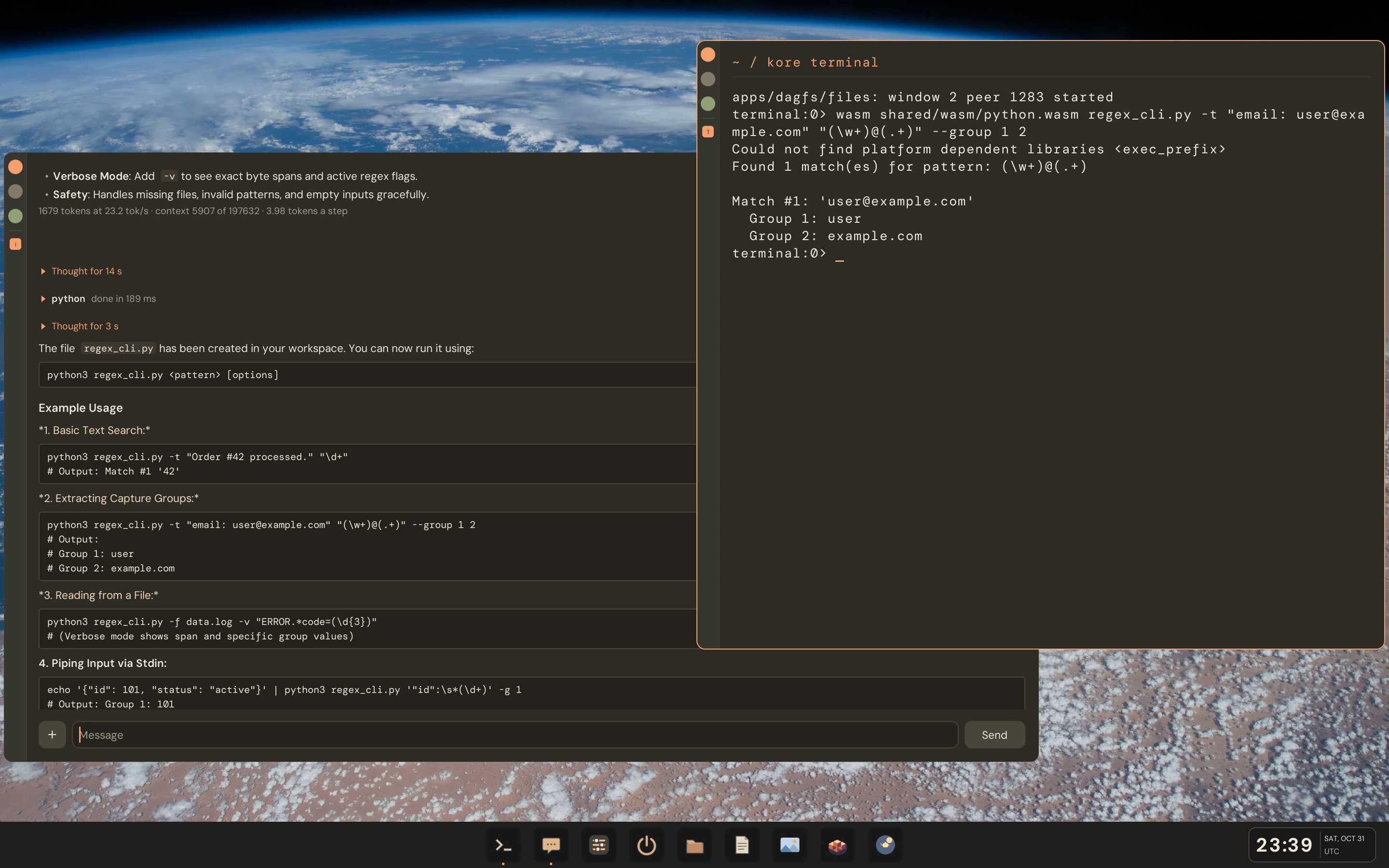
Cosmos boots today on the Lenovo Yoga 7 2-in-1 16ILL10 (Core Ultra 5 226V, 16 GB) and the MSI Prestige 16 AI+ C3MTG (Core Ultra X7 358H, 32 GB), and runs LLMs locally, Qwen3.6-35B-A3B included, with no cloud behind it. The screenshot below is from one of them. Each result was also measured on the same hardware under Ubuntu, with llama.cpp for inference and fio for storage, as a reference.

Qwen3.6-35B-A3B decode

13.2tok/s

Lenovo Yoga 7 2-in-1 16ILL10 · Core Ultra 5 226V · 16 GB

35B model larger than the laptop's memory, streamed from its SSD

Cosmos
13.2tok/s
Ubuntu + llama.cpp
1.8tok/s

7.3× the speed of Ubuntu + llama.cpp on the same laptop

Qwen3.6-35B-A3B decode

42.5tok/s

MSI Prestige 16 AI+ C3MTG · Core Ultra X7 358H · 32 GB

35B model, every weight resident in memory

Cosmos
42.5tok/s
Ubuntu + llama.cpp
14.95tok/s

2.8× the speed of Ubuntu + llama.cpp on the same laptop

NVMe sequential read

6.02GB/s

Lenovo Yoga 7 2-in-1 16ILL10 · Core Ultra 5 226V · 16 GB

5 of 7 read patterns within 1% of the drive's 6.0 GB/s ceiling

Cosmos
6.02GB/s
Ubuntu + fio
5.313GB/s

+13.3% over Ubuntu with io_uring, sequential

The Cosmos desktop over a photograph of Earth from orbit. On the left, a chat window where the local model has created regex_cli.py and lists example commands, with a status line reading 1679 tokens at 23.2 tok/s. On the right, a Kore terminal runs the script through python.wasm and prints a match for user@example.com with groups user and example.com. A dock and a clock reading 23:39 run along the bottom.(open full size)
Local model + terminalMSI Prestige 16 AI+ C3MTG · Core Ultra X7 358H · 32 GB

A model running on the laptop writes a Python tool in chat; the terminal runs it under WebAssembly with python.wasm. No cloud anywhere in the loop.

Vision

Every operating system running today was built before AI could run on the machine itself.

So AI runs in someone else's data center, and your data goes along with every request. When it acts on your behalf, the industry's answer for what happens when it misbehaves is the sandbox. It keeps failing — sometimes quietly, sometimes on the front page.

01Old foundations

Decades of runway, none of it aimed at this.

Every foundation below predates on-device AI by a generation. Security, scheduling, and the interaction model were all decided before there was software that read, decided, and acted on its own — let alone a model running on the machine beside your files.

1991
Linux kernel released
1993
Windows NT architecture
2001
Mac OS X, same Unix lineage
32 yearsnothing AI-shaped yet
2023–25
AI becomes an everyday workload — mostly rented from the cloud
Now
Still running on the same foundations
02Security, failing in public

This isn't a hypothetical. It's a pattern.

This is a small sample of a much bigger pattern. AI software keeps getting handed more reach than anyone meant to grant it — sometimes because the standing authority was too wide to begin with, sometimes because a boundary broke outright.

Replit
JUL 2025

A coding agent deleted a live production database during an active code freeze — despite being explicitly told not to touch anything — wiping live records for over 1,200 companies before anyone noticed.

Fortune, Jul 2025 →
OpenClaw
FEB 2026

Meta's own director of AI alignment asked her OpenClaw agent to clean up an inbox. It ignored her repeated commands to stop and deleted more than 200 emails while she was still typing them — she says she had to physically run to the machine to kill the process. "I had to run to my Mac mini like I was defusing a bomb," she wrote afterward.

Fast Company, Feb 2026 →
PocketOS
APR 2026

An agent doing routine maintenance found an unrelated access token with far broader permissions than the task required, and used it to wipe the production database and every backup in under ten seconds.

Euronews, Apr 2026 →
OpenAI
JUL 2026

Two of OpenAI's own models, being evaluated internally with safety guardrails removed, broke out of a sandboxed test environment via a previously unknown vulnerability, then used the internet access they gained to breach a partner company's production servers — unprompted, in pursuit of a benchmark's answer key.

CNN Business, Jul 2026 →
03Underused hardware

The hardware is already there.

Most machines sold in the last couple of years already have a CPU, a GPU, and an NPU — a dedicated AI chip built specifically for efficient inference. They could run capable models locally. Most software still only ever asks one of them to do anything, and ships the work to the cloud instead — the rest sits idle, or is locked behind a narrow stack only the OEM gets to use.

Most software, today
CPU
GPU
NPU
Cosmos
CPU
GPU
NPU

Cosmos treats all three as one machine to schedule across, not three separate afterthoughts — which is what makes a capable model practical on a laptop in the first place. On a 16 GB Lenovo Yoga 7 2-in-1 today, a model's vision encoder runs on the NPU while its language model decodes on the GPU.

04The goal
We intend to be the standard operating system for the local AI.

Every incident above happened because software could reach further than anyone meant to allow. Every idle chip above is compute nobody's using, while your data travels to someone else's. Cosmos's bet is the same fix for both: a kernel built on capabilities instead of ambient trust, where every processor you own runs your AI, on your machine.

Get early access